Nepal · Lumbini
Lumbini in One Day: A Quiet Guide to the Birthplace of the Buddha
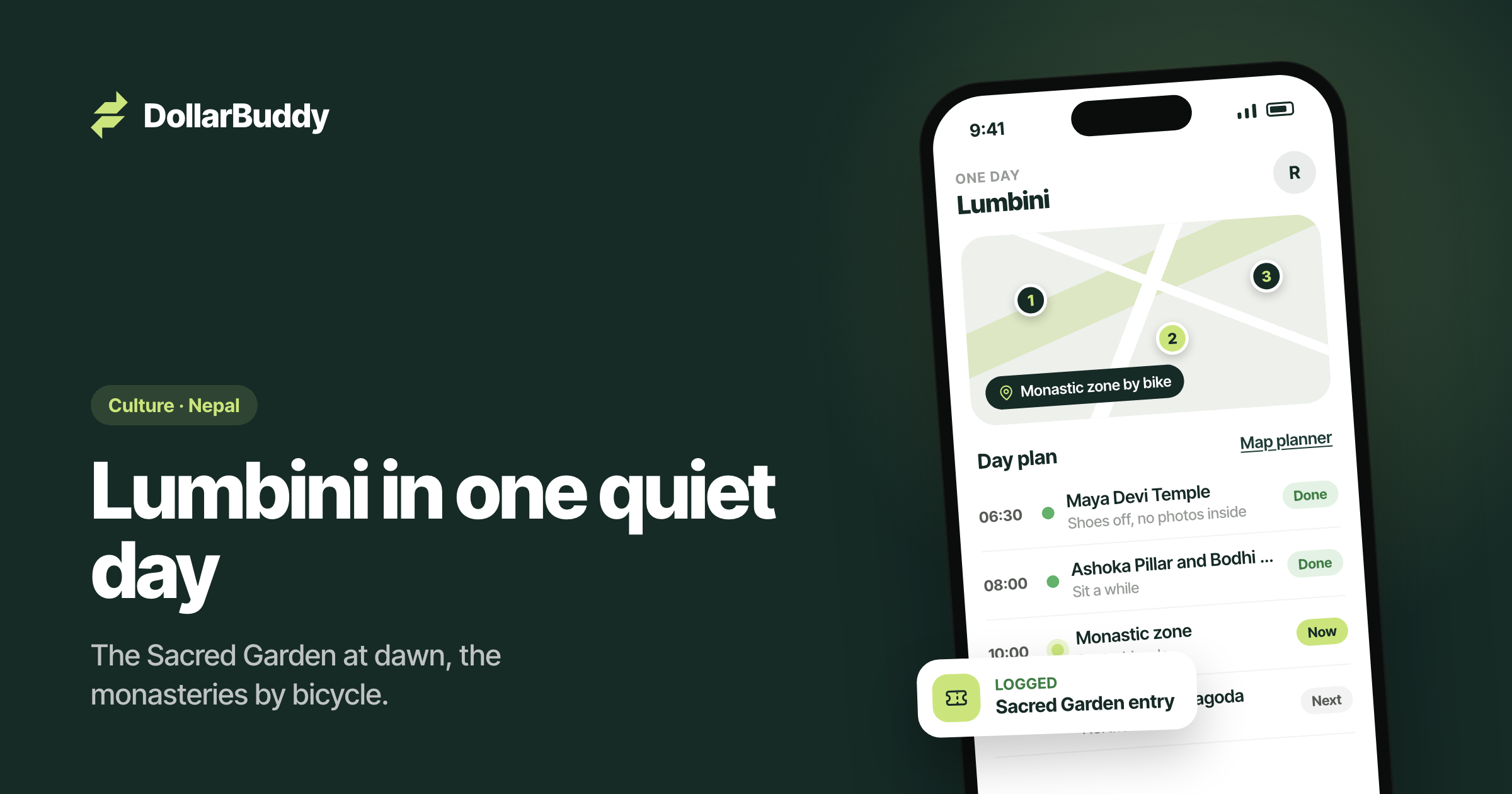
Lumbini is flat, hot and wide open. After the crowds of Kathmandu and the drama of the mountains, it can feel almost empty when you arrive. Give it an hour. The emptiness is the point.
This is where Siddhartha Gautama, who became the Buddha, was born, and the place has a stillness that is hard to describe until you are standing in it.
Start at the Sacred Garden
Go early, before the sun gets serious. The Sacred Garden is the heart of Lumbini, with the Maya Devi Temple at its centre.
Inside the temple, a walkway leads you around ancient excavated brick foundations, and at the centre is a marker stone, protected under glass, identified as the exact spot of the birth. People stand in front of it in complete silence. Some cry. Some just stand. You do not need to be Buddhist to feel something here.
Shoes come off before you enter. Photography inside is not allowed. Respect both.
Outside, next to the temple:
- The Ashoka Pillar, raised by the emperor Ashoka in the 3rd century BCE. Its inscription is one of the key pieces of evidence that this is the Buddha's birthplace.
- The Puskarini pond, where Maya Devi is said to have bathed before giving birth.
- The Bodhi tree, strung with thousands of prayer flags, with monks and pilgrims sitting in its shade.
Sit for a while. Under the tree is a good place to just be quiet.
The monastic zone by bicycle
North of the Sacred Garden stretches the monastic zone, a long site with a canal running down the middle, split into two halves. Countries and Buddhist communities from around the world have built monasteries here, each in its own national style.
So in one afternoon you can see a gleaming Thai temple, a Myanmar-style golden stupa, a German-built monastery with remarkable painted interiors, Chinese, Korean, Vietnamese and Tibetan styles, and more. It is like a small tour of how one idea grew in a dozen directions.
Rent a bicycle. The distances are bigger than they look on the map and the heat is real. Cycling between monasteries, with the wind on your face, is far nicer than walking.
At the northern end, the World Peace Pagoda and the eternal flame are worth the ride.
When to go
- October to March is the time. Mornings can be foggy and cool in winter, which makes for beautiful soft light.
- April to June is very hot on the plains. If you go then, start at dawn and rest through midday.
- Monsoon brings rain and humidity, but also fewer visitors.
Buddha Jayanti, the Buddha's birthday, usually falls in late April or May, and Lumbini fills with pilgrims. It is crowded and hot and very special.
Getting there
Lumbini is near Bhairahawa (Siddharthanagar), which has an international airport and is connected by bus to Kathmandu, Pokhara and Chitwan. It is close to the Indian border at Sunauli, so many travelers pass through on the way in or out of Nepal.
What to bring
- Sun hat, sunscreen and a lot of water.
- Socks, if the stone floors are hot. Bare feet on sun-heated stone at noon is a lesson you only need once.
- Small notes for donations at monasteries, if you want to give.
- A light scarf or shawl to cover shoulders.
Costs, briefly
Lumbini is one of the gentler places in Nepal on the wallet. There is an entry fee for foreign visitors at the Sacred Garden, bicycle or e-rickshaw hire is cheap, and food in the town nearby is simple and affordable. The biggest cost is usually just getting there.
A different kind of day
Most travel days are about doing. Lumbini is one of the rare ones about slowing down. You will not leave with a lot of photos, since you cannot take them in the most important room. You will leave with a quiet that stays with you for a while on the bus ride out. That is a good trade.
Frequently Asked Questions
- Is one day enough for Lumbini?
- One full day covers the Sacred Garden and a good part of the monastic zone. Stay a night if you want to see it in early morning and evening light.
- How do I get around Lumbini?
- The site is large and flat. Renting a bicycle is the easiest way to move between the Sacred Garden and the monasteries. Electric rickshaws are also available.
- What should I wear in Lumbini?
- Clothes that cover shoulders and knees, and shoes that are easy to take off. You will remove them at the Maya Devi Temple and at many monasteries.