group travel · splitting expenses
How to Split a Vacation Rental Fairly When Stays Differ
Updated November 2026.
How to split a vacation rental fairly comes down to one question: did everyone get the same thing? If everyone stays every night in similar rooms, split it equally. If people stay different numbers of nights, split by night-shares (total divided by person-nights). If the rooms are clearly unequal, split by room. Agree on the method before anyone books, put the full checkout total into the math, and settle before the trip ends.
The rental is usually the biggest single cost of a group trip, and it is the one most likely to cause a quiet grudge. Someone arrives a day late. A couple gets the room with the private bathroom. One friend fronts the whole booking on their card and then waits weeks to be paid back. Here is how to handle each case, with one worked example you can copy.
Key takeaways
- Equal splits are fair only when everyone gets the same nights and similar rooms.
- Night-shares fix the late arrival problem: divide the total by person-nights, then multiply by each person's nights.
- Room-based splits fix the "better room" problem. Price rooms before booking, not at checkout.
- Split the full checkout total, including cleaning and service fees. On Airbnb, the guest service fee is a percentage of the booking subtotal, so it scales with everything else.
- Decide the dropout rule and the settle-up date before anyone pays a deposit.
The example we will use
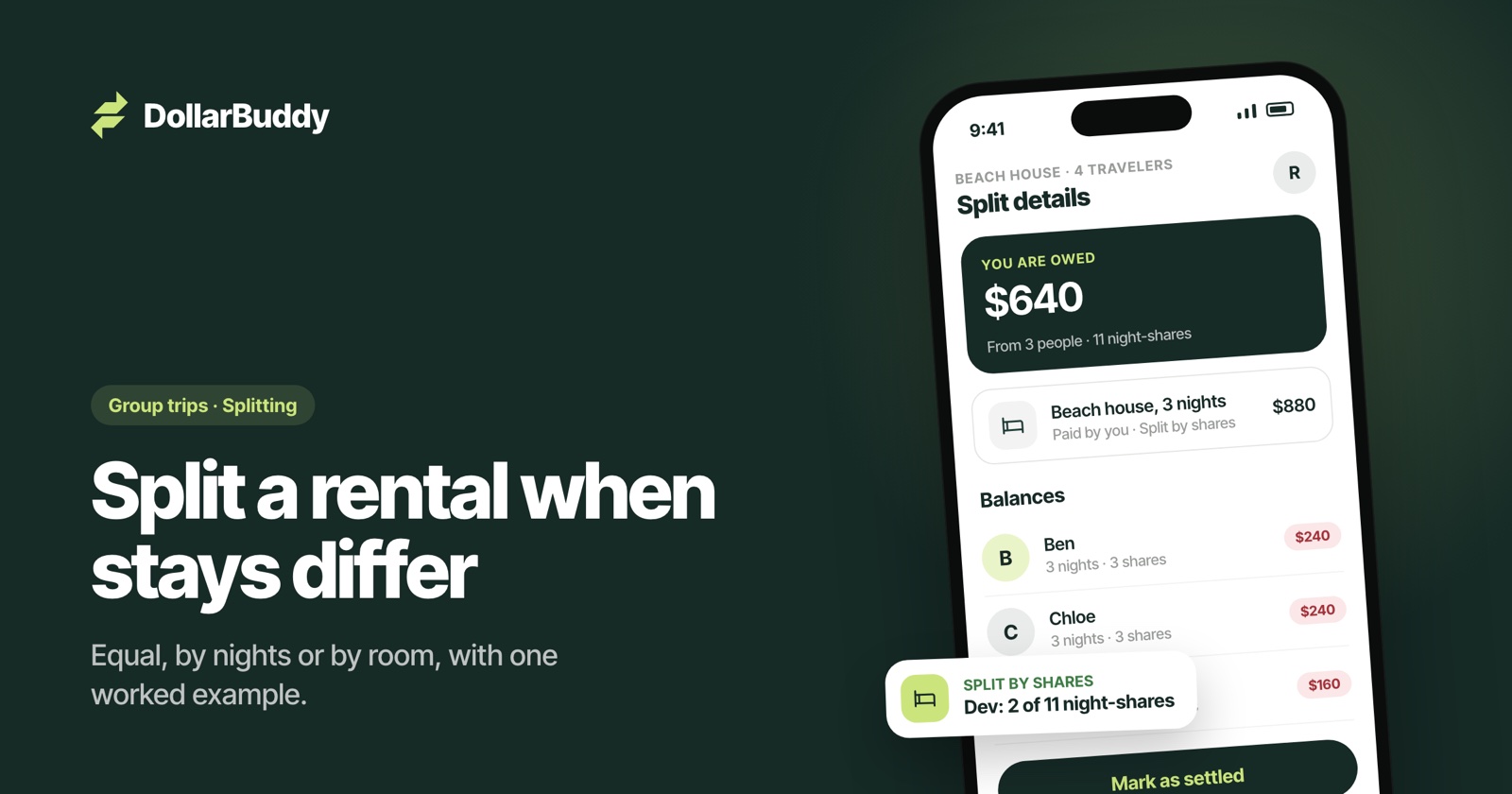
Four friends book a house for three nights. The checkout total, with cleaning and service fees included, is $880.
- Ana, Ben and Chloe stay all 3 nights.
- Dev arrives a day late and stays 2 nights.
- The house has four bedrooms, and one of them is a large master with its own bathroom.
Here is what each person pays under four common methods.
| Method | Ana | Ben | Chloe | Dev | Best when |
|---|---|---|---|---|---|
| Equal | $220 | $220 | $220 | $220 | Same nights, similar rooms |
| By nights (night-shares) | $240 | $240 | $240 | $160 | Stays differ, rooms similar |
| By room (exact amounts) | $280 | $220 | $200 | $180 | Rooms differ, same nights |
| Hybrid (fees equal, nights by stay) | $237.50 | $237.50 | $237.50 | $167.50 | Big fixed fees, stays differ |
Every row adds up to $880. The method changes who pays what, never the total. The sections below show how each row was worked out.
How to split a vacation rental equally
Divide the total by the number of people: $880 / 4 = $220 each.
This is the right answer more often than people think. If everyone stays every night and the rooms are roughly the same, an equal split is fair, fast and impossible to argue about. It is also the default in most bill-splitting apps.
The problem is Dev. Under an equal split, Dev pays $220 for two nights while the others pay $220 for three. Dev is effectively paying $110 a night and everyone else about $73. That is the kind of gap that does not get mentioned on the trip but gets remembered after it.
How to split an Airbnb by nights when stays differ
Use night-shares (also called person-nights). Each person gets one share for each night they stay.
- Count the shares: Ana 3 + Ben 3 + Chloe 3 + Dev 2 = 11 night-shares.
- Find the value of one share: $880 / 11 = $80.
- Multiply by each person's nights: 3 x $80 = $240 for the full-stay friends, 2 x $80 = $160 for Dev.
Check: $240 + $240 + $240 + $160 = $880.
Night-shares are the fairest method for the most common group-trip problem: people arriving and leaving on different days. They also handle bigger gaps well. If someone only joins for one night of a seven-night villa, they pay one share, not a seventh of the bill and not an equal split.
One judgment call: if a house costs the same whether three or four people sleep in it, some groups ask the late arrival to pay a little more than strict night-shares, because the others carried the first night alone. That is a group decision, not a rule. Decide it before booking.
How to split a rental when rooms are not equal
When one room is clearly better (a private bathroom, a view, a real bed instead of a sofa bed), split by room instead of by person.
Before you book, agree on a price for each room so the room prices add up to the total. In our example, the group agrees:
| Room | Agreed price | Who sleeps there |
|---|---|---|
| Master with bathroom | $280 | Ana |
| Double room | $220 | Ben |
| Smaller double | $200 | Chloe |
| Single room | $180 | Dev |
| Total | $880 |
In an app, this is an exact amounts split. You can also use percentages if your group prefers to think that way (the master is about 32% of the total here).
Two tips that prevent arguments:
- Price rooms before the booking is confirmed. Once people have picked rooms, every price looks unfair to someone.
- Couples usually pay for one room, not two people. If a couple shares the master, they split the $280 between them. If you are splitting by person or by nights instead, a couple counts as two people. Pick one rule and say it out loud.
If rooms differ and nights differ, combine the two: give each room a weight (for example master = 1.3, others = 1.0), multiply by nights, and use those as shares.
Who pays the cleaning fee and service fees?
Treat every fee as part of the rental. The total that matters is the amount charged at checkout, not the nightly rate in the listing.
Booking platforms build fees into that total in different ways:
- On Airbnb, listings use either a split-fee or a single-fee structure. Under the split-fee structure, Airbnb's help center says guests pay a service fee of 14.1% to 16.5% of the booking subtotal, and that subtotal includes the nightly price plus any additional fees charged by the host, like cleaning. Under the single-fee structure, the fee is deducted from the host's payout instead.
- On Vrbo, the traveler service fee is a percentage of the reservation total before taxes and refundable fees, and the percentage varies with the reservation amount.
Because the service fee rises with the subtotal, splitting the full checkout total with your chosen method is the simplest fair approach.
The hybrid split is useful when one fee is large and does not depend on nights, like a cleaning fee. Say $110 of the $880 is cleaning. Split that equally ($27.50 each), then split the remaining $770 by night-shares ($770 / 11 = $70 a share). Full-stay friends pay $210 + $27.50 = $237.50, and Dev pays $140 + $27.50 = $167.50. The logic: the house gets cleaned once no matter who stayed which night.
Do not forget the costs that sit outside the booking, such as a refundable damage deposit, local tourist taxes collected on arrival, or parking. Our post on hidden travel costs nobody budgets for covers the usual suspects.
Who books, and how to collect the money
Most booking platforms charge one card for the whole stay, so one person usually fronts it. That person is lending money to the group, so make it easy for them:
- Agree on the method and the rooms in the group chat first. Screenshot it.
- Collect deposits before the booking. Many groups ask for each person's share (or a fixed deposit) to be sent to the booker within a day or two.
- Set the dropout rule. For example: if the booking is still refundable, the person leaving gets their share back; if not, they pay unless someone replaces them.
- Log the rental as one shared expense with the agreed split, so it nets against every other cost on the trip (groceries, taxis, dinners).
- Settle before you fly home. Balances that wait until "after the trip" tend to wait forever.
If you are new to group money, our guide to splitting travel expenses with friends covers the money chat to have before the trip, and how to create a travel budget helps everyone agree on a per-person number first.
Splitting a vacation rental in DollarBuddy
We make DollarBuddy, a travel budgeting and group expense app, so here is how this works in it. Create a trip, add your travelers, and log the rental as one shared expense. You can split it equally, by exact amounts, by percentage or by shares, all on the free plan. For the night-shares method, give Ana, Ben and Chloe 3 shares each and Dev 2, and the app works out $240, $240, $240 and $160.
Friends who do not have the app can be added as guests, and guests do not count toward the free plan's limit of 4 travelers per trip (Pro removes the limit). Every other shared cost on the trip updates the same running balance, and at the end DollarBuddy nets everything out so the group settles in as few payments as possible. Settling is recorded in the app, and you pay each other however you like.
See how it works for your group on the group trips page, or read the step-by-step splitting bills guide. Comparing tools? Here is how DollarBuddy compares with Splitwise.
The short version
- Same nights, similar rooms: equal.
- Different nights: night-shares (total / person-nights x your nights).
- Different rooms: by room, priced before booking.
- Big fixed fees plus different nights: hybrid.
- Always split the full checkout total, agree before booking, and settle before you leave.
Frequently Asked Questions
- What is the fairest way to split a vacation rental?
- If everyone stays every night in similar rooms, split it equally. If people stay different numbers of nights, split by night-shares: divide the total by the number of person-nights, then multiply by each person's nights. If rooms are clearly unequal, price each room and let people pay for the room they sleep in.
- How do you split an Airbnb when someone arrives late?
- Count person-nights. For an $880 stay where three friends stay 3 nights and one stays 2, there are 11 person-nights, so each night is worth $80. The three full-stay friends pay $240 each and the late arrival pays $160.
- Should couples pay double when splitting a rental?
- Usually a couple sharing one bed pays for one room, not two people, when you split by room. When you split by person or by nights, a couple counts as two people. Agree on which rule you are using before you book so nobody feels singled out.
- Who pays the cleaning fee and the service fee?
- Treat them as part of the total. Airbnb calculates its guest service fee on the booking subtotal, which includes the nightly price and host fees like cleaning, so the simplest fair approach is to split the full checkout total with your chosen method. A hybrid split, where fixed fees are shared equally and nightly costs by nights, also works.
- What happens if someone drops out after booking?
- Agree on a rule before anyone pays. A common one: if the booking can still be refunded, the person leaving gets their share back; if it cannot, they pay their share unless someone takes their place.