travel budget · money
After the Trip: A 20-Minute Money Review That Makes Your Next Trip Better
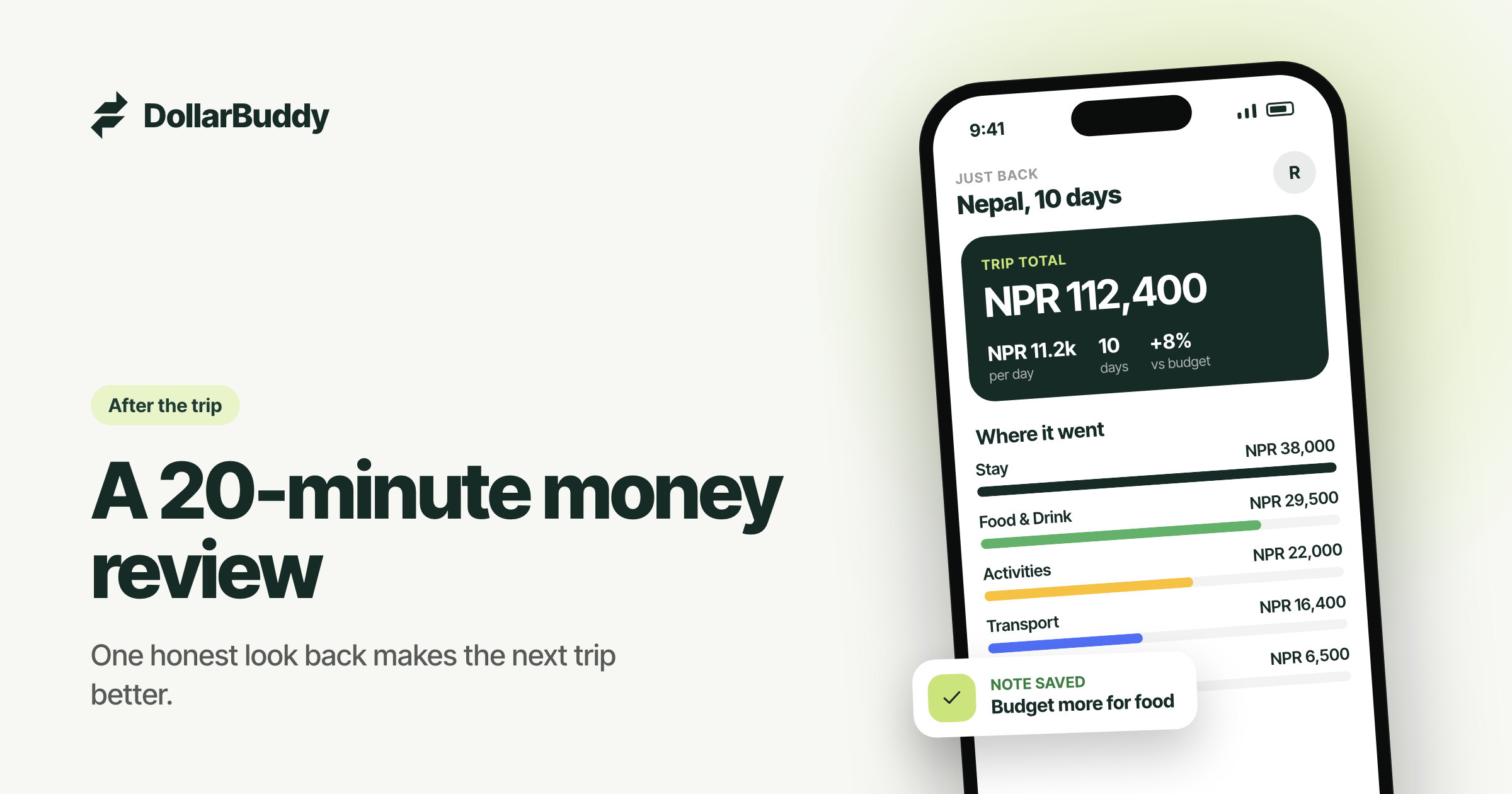
There is a moment after every trip that nobody puts on Instagram. You are home, the suitcase is still half full in the corner, you are tired in a good way, and you open your banking app with one eye closed.
We used to avoid that moment for weeks. Now we lean into it, because a short, honest look back is the best travel planning tool we know.
Here is the 20-minute review we do after every trip.
Minute 1 to 5: Get the real total
First, find out what the trip actually cost. Not what you think it cost. Everything:
- Flights and transport, including transfers to and from airports
- Accommodation
- Food and drink
- Activities, tickets and entry fees
- Shopping and gifts
- Fees: ATM, foreign transaction, visa, baggage
- Everything else
If you logged expenses during the trip, this part takes a minute. If you did not, you will be digging through card statements, cash withdrawals and memory. (That is the best argument for logging as you go.)
Convert everything into your home currency so you can see one honest number.
Minute 5 to 10: Compare plan vs reality
Put your original budget next to the real total. Then look category by category.
Usually, a pattern shows up quickly:
- Accommodation is often close to plan, since it was booked in advance.
- Food tends to run over. Especially coffees, snacks and "we are on holiday" dinners.
- Transport inside the destination is often underestimated.
- Entry fees and activities are frequently missing from the original plan entirely.
The point is not to feel guilty. The point is to find your own pattern. Everyone has one category that always runs over. Once you know yours, you can budget for it honestly next time.
Minute 10 to 13: Find your daily number
Divide the on-the-ground spending (everything except flights and pre-paid bookings) by the number of days.
That number is gold. It is your real daily cost of travel in that kind of place, traveling the way you actually travel. Not a number from a blog. Yours.
Over a few trips, you will start to know your daily cost for "big city in Southeast Asia", "trekking in Nepal" or "road trip at home", and planning gets much faster and more accurate.
Minute 13 to 16: The three surprises
Scroll through your expenses and pick the three that surprised you most. The ones that made you say "wait, really?"
For us it has been things like: a taxi from the airport at night that cost more than the next three days of transport, a single dinner that cost as much as a hotel night, or a slow drip of ATM fees from lots of small withdrawals.
Ask of each one: was it worth it? Some will be. That special dinner probably was. Some will not, and those are the ones you plan around next time.
Minute 16 to 18: Settle up
If you traveled with friends or family, settle shared costs now, while everyone still remembers. Make sure every shared expense is accounted for, work out who owes whom, and pay it.
Unsettled trip money is one of the most common quiet tensions between friends. A week later it is awkward. A month later it is a story someone tells about you. Settle it in the first few days.
Minute 18 to 20: Write three notes for next time
Finish by writing down three short notes, somewhere you will actually find again:
- My real daily cost was: ...
- Next time, budget more for: ...
- Next time, skip or change: ...
That is it. Three lines. They will be the first thing you read when planning your next trip.
Why bother?
Because travel money is not really about money. It is about freedom. When you know what a trip actually costs you, you stop guessing, you stop being shocked by statements, and you can say yes to the next adventure with a clear head.
Twenty minutes. One honest look. And the next trip is already a little better.
Frequently Asked Questions
- Why should I review my spending after a trip?
- It turns one trip's spending into real data for the next one. You learn your actual daily cost of travel, which categories run over, and how much buffer you need.
- What should I compare in a post-trip review?
- Planned versus actual total, spending by category, average daily spend, and the few individual expenses that surprised you most.
- When is the best time to do a trip money review?
- Within a week of getting home, while memories are fresh and before card statements pile up with everyday spending.