travel money · budget travel
Cards, Cash and ATMs Abroad: How to Stop Losing Money to Fees
On our first few trips, we never really lost money. Nobody pickpocketed us. Nobody ran off with a wallet. And yet at the end of every trip, the numbers never matched. We had spent more than we thought, and we could not point to where.
It took a while to realise: the money was not stolen. It was leaking, quietly, through fees and exchange rates, a few percent at a time.
Here is everything we learned about plugging those leaks.
The one question that costs travelers the most
You tap your card abroad, or put it into an ATM, and the screen asks:
"Pay in [your home currency] or [local currency]?"
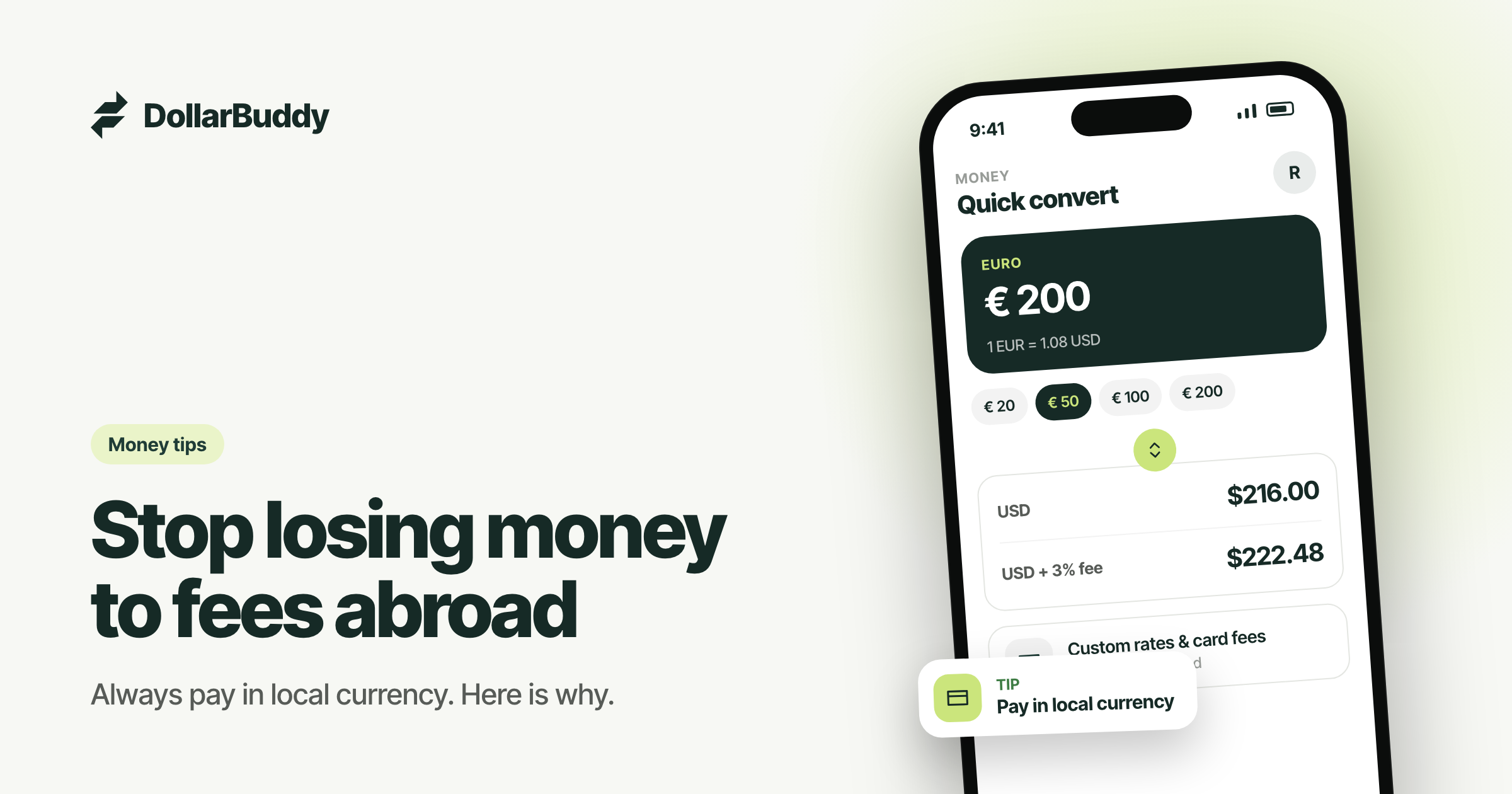
It looks like a helpful offer. It is not. Choosing your home currency triggers something called dynamic currency conversion, where the shop or ATM decides the exchange rate. That rate is usually noticeably worse than the one your own bank would give you.
Always choose the local currency. Every time. At the restaurant, at the hotel, at the ATM. This one habit probably saves more than every other tip in this post combined.
Know what your card actually charges
Before you travel, spend ten minutes finding out:
- Does your card charge a foreign transaction fee on every purchase abroad? Many do, often a few percent.
- Does your bank charge a fee for ATM withdrawals abroad?
- Will your bank block your card if it sees foreign transactions? Some banks still do. Tell them you are traveling if they offer that option.
If your main card charges heavy foreign fees, it may be worth getting a travel-friendly card before your trip. It does not need to be fancy. It just needs to stop charging you for being abroad.
ATMs: fewer, bigger withdrawals
Local ATMs often charge their own flat fee for foreign cards, on top of your bank's fee. Since it is flat, the fee hurts more on small withdrawals.
- Take out larger amounts less often, within what you feel safe carrying.
- Use ATMs attached to banks, inside the branch if possible, in daylight.
- Cover the keypad. Check the card slot for anything that looks loose or added.
- Decline the "convert to your home currency" offer on the screen. (See above. It is always there.)
How much cash to carry
It depends completely on where you are.
In some cities you barely need cash. On a Himalayan trek, there are no ATMs for days and almost nobody takes cards, so you carry everything you need from the last town, plus a buffer.
A good default:
- Cash for a day or two of normal spending in your wallet.
- An emergency reserve, cash plus a backup card, stored separately. Different bag, different pocket, money belt, whatever works.
- Small notes. Big notes are hard to break at markets, taxis and teahouses, and "no change" is a very common way to end up overpaying.
Exchanging cash
- Avoid airport exchange counters for large amounts. Change just enough for a taxi and a first meal, then exchange the rest in town or use an ATM.
- Compare the buy and sell rates at a counter. The gap tells you how much they are keeping.
- "Zero commission" usually means the commission is built into the rate.
- Count your money at the counter before you walk away.
Carry two cards, keep them apart
Cards get swallowed by ATMs, blocked by fraud systems, or lost. Carry at least two, ideally on different networks (for example, one Visa and one Mastercard), and keep them in different places. If one disappears, you are inconvenienced instead of stranded.
Track it in your own currency
Here is the final leak. When you spend in a currency you do not think in, every price feels a bit unreal. Two hundred of something sounds like a lot or like nothing, depending on the country, and the brain gives up and just taps the card.
The fix is simple: record each expense with the amount in the local currency, and see it converted into your home currency. After a day or two you develop a feel for prices, and you start noticing when something is actually expensive. That awareness saves more money than any discount.
The short version
- Always pay in local currency.
- Know your card's foreign fees before you go.
- Fewer, bigger ATM withdrawals, from bank ATMs.
- Carry small notes and an emergency reserve in a separate place.
- Track your spending in your home currency.
None of this is exciting. But it is the difference between a trip that feels like it cost what you planned, and one that leaves you wondering where it all went.
Frequently Asked Questions
- Should I pay in my home currency or the local currency abroad?
- Almost always the local currency. Choosing your home currency triggers dynamic currency conversion, where the merchant or ATM sets the exchange rate, usually at a worse rate than your bank.
- How much cash should I carry when traveling?
- Enough for a day or two of spending plus an emergency reserve in a separate place. In cash-heavy places, such as mountain trails without ATMs, carry enough for the whole stretch.
- Is it better to exchange money before I travel?
- Usually not in large amounts. Airport and home-country exchange rates are often poor. Bring a small amount for arrival and use local ATMs or reputable exchange counters for the rest.