Europe · travel money
Paying Your Way Around Europe: Which Countries Use the Euro, and How to Avoid Card Traps
Updated November 2026.
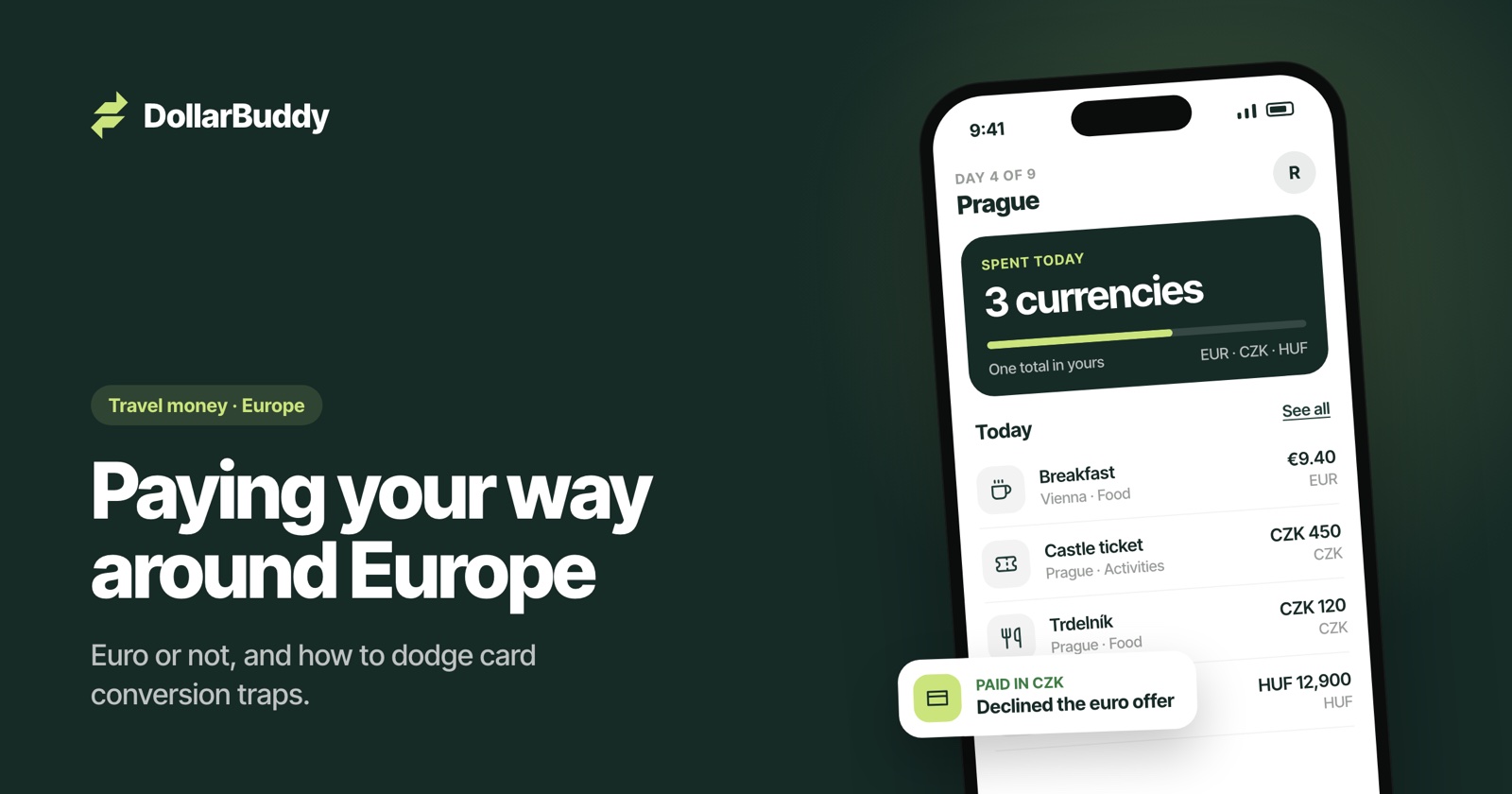
Which European countries use the euro, and how should you pay when they don't? Europe looks like one big euro-shaped market from far away. Up close, it is a patchwork. Your card will work almost everywhere, but you might pay in euros in Vienna, koruna in Prague and forints in Budapest in the same week. That is where travelers lose money, not on the big costs but on how each payment gets converted.
Here is which countries use what, and the handful of habits that keep conversion fees off your trip.
Key takeaways
- 21 EU countries use the euro as of 2026. Bulgaria joined on January 1, 2026.
- Popular destinations that do not use the euro include Czechia, Hungary, Poland, Denmark, Sweden, the UK and Switzerland.
- Always pay in the local currency. Decline "pay in your home currency" at card machines and ATMs.
- Contactless payment is the norm in most cities. Keep a little cash for markets and small places.
- A card with no foreign transaction fee saves more over a trip than any exchange-rate hunting.
Which countries use the euro in 2026?
The euro area now has 21 members, after Bulgaria adopted the euro on January 1, 2026:
Austria, Belgium, Bulgaria, Croatia, Cyprus, Estonia, Finland, France, Germany, Greece, Ireland, Italy, Latvia, Lithuania, Luxembourg, Malta, the Netherlands, Portugal, Slovakia, Slovenia and Spain.
A few non-EU places also use the euro, including Montenegro, Kosovo, Andorra, Monaco, San Marino and Vatican City.
European countries that don't use the euro
| Country | Currency | Good to know |
|---|---|---|
| Czechia | Czech koruna (CZK) | Prague is the classic place to be offered euros at a poor rate. Pay in koruna. |
| Hungary | Hungarian forint (HUF) | Budapest prices often run into the thousands of forints. It is normal. |
| Poland | Polish złoty (PLN) | Cards widely accepted in Kraków and Warsaw. |
| Denmark | Danish krone (DKK) | Very card-friendly. Some places are card-only. |
| Sweden | Swedish krona (SEK) | One of the most cashless countries in Europe. |
| Romania | Romanian leu (RON) | Carry some cash outside the big cities. |
| United Kingdom | Pound sterling (GBP) | Contactless works on London transport. |
| Switzerland | Swiss franc (CHF) | Some places accept euros, but change is usually given in francs at their rate. |
| Norway | Norwegian krone (NOK) | Highly card-based. |
Pay in the local currency: avoid dynamic currency conversion
When you tap a foreign card, the terminal may ask: pay in EUR or in USD? (or GBP, AUD, INR, and so on). The home-currency option is dynamic currency conversion. It looks helpful because you see a familiar number, but the merchant's provider sets the exchange rate, and it is usually worse than your card network's.
The same trick shows up at ATMs as a "guaranteed conversion" or "we'll convert for you" screen. Decline it and withdraw in the local currency.
This rule is the same everywhere you travel, from Lisbon to Dubai to Kathmandu. We go deeper on ATM fees and travel cards in Cards, Cash and ATMs Abroad.
Cards or cash in Europe?
- Contactless is everywhere in most European cities, including public transport in many of them. Phone wallets work wherever contactless does.
- Cash still matters at Christmas markets, small cafes, some rural guesthouses, and for tips. Some places, particularly smaller businesses in Germany, Austria and southern Europe, still prefer cash.
- Use bank-branded ATMs where you can. Independent machines in tourist areas often charge their own fee on top of your bank's.
- Withdraw less often, in larger amounts, to spread any fixed fee.
ATM fees in Europe: how to keep them small
There are usually two possible charges on a foreign withdrawal: your own bank's fee, and a fee from the ATM operator. You control both more than you might think:
- Prefer machines belonging to a local bank, inside or attached to a branch. Standalone machines in tourist zones and airports are the ones most likely to add their own charge.
- Read every screen before you confirm. Any fee should be shown before the cash comes out. If it looks high, cancel and find another machine.
- Decline the conversion offer. Choose to be charged in the local currency, then let your card network convert.
- Withdraw fewer, larger amounts so a fixed fee is spread over more cash.
Tipping in Europe, briefly
Tipping customs vary by country, and they are generally more modest than in the US. In many places a service charge is already included on restaurant bills, so check before you add anything. Where it is not, rounding up or leaving a small percentage for good table service is common. Taxi drivers are often tipped by rounding up the fare.
Before you go: a 5-minute travel money checklist
- Check your card's foreign transaction fee. Many cards add up to 3% on every purchase abroad. On a €2,000 trip, that is about €60.
- Bring two cards from different banks, and keep them in different places.
- Tell your bank you are traveling, if your bank still asks for that.
- Note which countries on your route are not on the euro.
- Decide how you will track spending when you are paying in three currencies.
Tracking a trip in several currencies
Multi-country trips are where spending gets blurry: €45 here, 1,200 koruna there, 18,000 forints for dinner. In DollarBuddy you log each expense in the currency you paid, and the trip total shows in your home currency. If your card charges a foreign fee, you can add it once in Custom rates (a Buddy Pro feature) and every total includes it.
Comparing destinations first? See what a day costs in Portugal, Spain, Italy, Greece and Budapest, or try the free trip cost estimator.
Currency and fee details can change. Check with your bank and the official sources linked above before you travel.
Frequently Asked Questions
- How many countries use the euro in 2026?
- 21 EU countries use the euro. Bulgaria became the 21st member of the euro area on January 1, 2026. Several European countries still use their own currency, including Czechia, Hungary, Poland, Denmark, Sweden, Romania, the UK, Switzerland and Norway.
- Should I pay in euros or my home currency when my card is asked?
- Pay in the local currency, always. If the card machine or ATM offers your home currency, that is dynamic currency conversion, and it usually uses a worse exchange rate than your own card network.
- Do I need cash in Europe?
- Less than you used to. Contactless card and phone payments are widely accepted across most of Europe. Keep a small amount of local cash for markets, small cafes, rural areas and tips.
- Is it better to exchange money before I travel to Europe?
- Usually not much. Airport and hotel exchange counters tend to have poor rates. A card with no foreign transaction fee, plus a small ATM withdrawal from a bank's machine on arrival, is often cheaper.