Nepal · Kathmandu
Kathmandu in 3 Days: A First-Timer's Guide That Skips the Rush
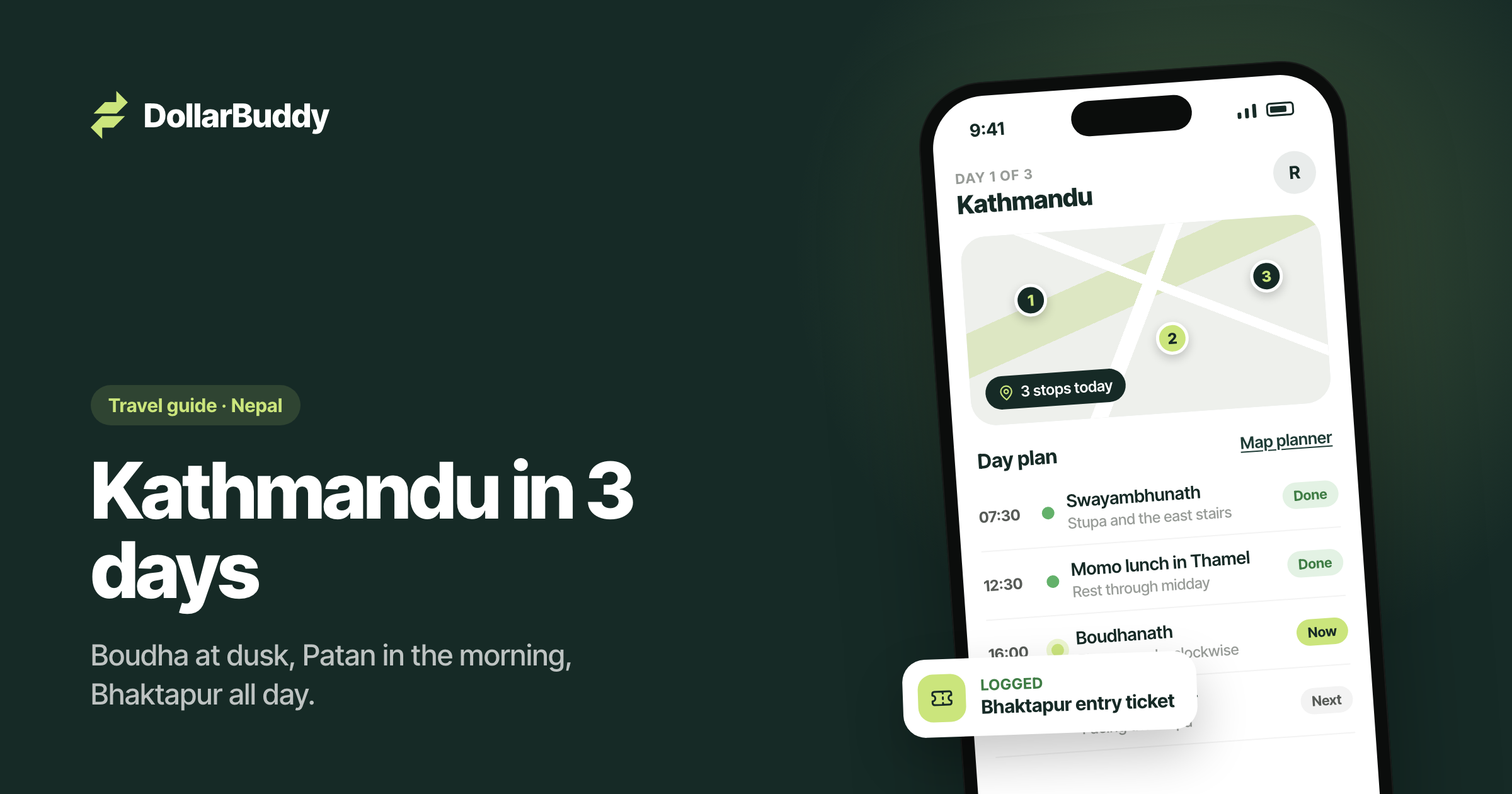
Most people treat Kathmandu as a waiting room. You land, you sleep off the flight, you buy a fake North Face jacket in Thamel, and you leave for the mountains as fast as the bus will take you.
We get it. But the valley deserves more than a layover. Give it three days and it stops being the dusty, honking city you see from the airport road and starts being what it actually is: three old kingdoms, still lived in, still praying, still selling yoghurt out of clay pots.
Here is how we would spend those three days if a friend asked us.
Day 1: Swayambhu in the morning, Boudha at dusk
Start early at Swayambhunath. The long stone staircase from the eastern side is the best way up, partly because it is beautiful and partly because it earns you the view. Go before 8 am and you will share the stupa with locals doing their morning rounds, the smell of butter lamps, and a lot of monkeys who know exactly what is in your bag. Keep your snacks zipped.
From the top you can see the whole valley sprawl out. On a clear winter morning the snow peaks sit along the northern edge like someone painted them on.
Spend the middle of the day slow. Eat momo, drink tea, sleep if the jet lag wins.
Then go to Boudhanath around 4 pm. This is the part of the day we love most. The light goes gold on the white dome, the pigeons lift all at once, and the walking starts. People circle the stupa clockwise, some spinning prayer wheels, some chanting, some just on their evening walk with a phone in one hand and mala beads in the other. Join them. Walk clockwise. Do three rounds and you will understand why people come back here for years.
Climb up to one of the rooftop cafes facing the stupa for dinner. It costs a little more than eating on the street, but you are paying for the view and nobody minds if you stay a long time.
Day 2: Patan, the quiet one
Patan (Lalitpur) is just across the Bagmati river and it feels like a different city. Calmer, more crafted, less shouting.
Get to Patan Durbar Square in the morning and go straight into the Patan Museum. Even if museums are not your thing, this one is. The building itself is a restored palace courtyard, and the bronze and wood work inside is the kind of detail you will start noticing everywhere in the valley once you have seen it up close.
After that, get lost on purpose. The lanes north of the square open into small courtyards with shrines in the middle, kids playing badminton, and old men sitting on the stone steps of a pati (rest house). The Golden Temple (Hiranya Varna Mahavihar) is a few minutes' walk and worth it. Take your shoes and anything leather off where asked.
For lunch, look for a Newari place and order a set: beaten rice, buffalo choila, black soybeans, spicy potato, and a small bowl of something you will not be able to name. Ask what it is. People are usually happy to explain.
Day 3: Bhaktapur, give it the whole day
If you only had time for one old city, we would tell you Bhaktapur. Traffic is restricted in much of the core, so it is the most walkable of the three, and it feels like the city has decided on its own pace.
Go to Durbar Square, then walk to Taumadhi Square to see Nyatapola, the five-tiered temple with stone guardians on every level of the staircase. Then walk to Pottery Square and watch people throw clay on hand-turned wheels with the finished pots drying in rows in the sun.
Eat juju dhau, the "king of curd". It comes in a small clay bowl, thick and sweet, and you will want another one.
Stay until late afternoon when the day-trippers leave and the squares fill back up with locals. That is when Bhaktapur feels most like itself.
Getting around
- Ride apps: Pathao and InDrive are widely used and usually cheaper than flagging a taxi. You agree on the price before you get in, which saves the negotiation.
- Taxis: if you take one off the street, agree on the fare before you sit down.
- Walking: inside Thamel, Patan and Bhaktapur, your feet are the fastest vehicle.
- Dust: Kathmandu can be very dusty, especially in the dry season. A simple mask in your pocket makes a real difference.
What it costs
We will not pretend to give you exact prices, because they change and they depend on how you travel. But the shape of the spend is predictable:
- Entry fees are the line most people forget to budget. Each major heritage site charges foreign visitors separately, and over three days they add up to more than your food.
- Food can be very cheap if you eat where locals eat. A plate of momo or a dal bhat set at a local spot costs a fraction of a tourist-street cafe.
- Transport inside the valley is cheap with ride apps. Bhaktapur is the longest ride.
- Rooftop views cost extra, in coffee prices. Pick one or two moments where it is worth it.
Our tip: log everything in your home currency as you go, including those entry tickets. By day three you will know exactly what Kathmandu costs for the way you travel, which is a much better number than anything a blog can give you.
One last thing
Kathmandu is not a city that impresses you all at once. It gets you slowly, on the third round of Boudha, or in a courtyard in Patan when the bells start and nobody around you looks up because it happens every day. Give it the time. The mountains will still be there on day four.
Frequently Asked Questions
- Is 3 days enough for Kathmandu?
- Three days covers the big heritage sites of the valley without rushing. If you want to add day hikes like Nagarkot or Shivapuri, give it five.
- How do I get around Kathmandu cheaply?
- Ride apps like Pathao and InDrive are widely used and usually cheaper than street taxis. For short hops inside Thamel or the old city, walking is often faster than any vehicle.
- Do heritage sites charge entry fees?
- Yes. Boudhanath, Swayambhu, Patan Durbar Square and Bhaktapur all charge foreign visitors an entry fee. Keep your ticket, since some are checked again inside or valid for repeat visits.